
Blog
Follow us - Get quick access to the latest industry news!


2026-07-31 16:51:46
eva beach bags have holes for three practical reasons — drainage, ventilation, and weight reduction — and increasingly as a fourth: customization. Sand and water fall straight through instead of collecting in the bottom, air moves through the bag so damp towels or swimwear don't sit sealed against wet EVA, and removing material at the hole pattern makes the bag lighter without weakening the structure. On top of that, hole placement and pattern have become their own design feature, sold as a customizable option rather than a fixed factory default.
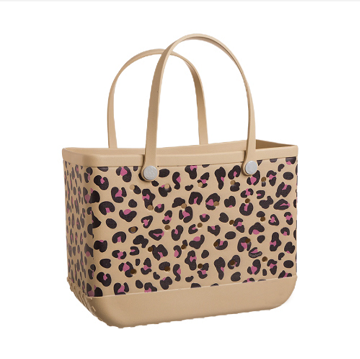
A solid-bottomed tote at the beach collects sand and water whether or not it's meant to. Perforated EVA lets both fall through as they land instead of pooling at the base, which is the main reason this hole pattern started appearing on beach totes in the first place — it solves a problem specific to sand and standing water that a fabric tote doesn't have in the same way.
A closed eva tote holding a wet towel or swimsuit traps moisture against the material with no airflow, which is a fast way to get a musty smell even from a material that doesn't absorb water itself. Holes let air move through the bag's interior, so damp contents get some passive drying rather than sitting sealed in trapped humidity until the bag is unpacked.
EVA is molded as a solid material by default, and a fully solid tote at the size and wall thickness used for these bags would weigh noticeably more than a perforated one. Removing material at a hole pattern cuts weight without needing to thin the walls overall, which would reduce structural rigidity. This is why holes tend to be placed across the body panels rather than at stress points like the base or handle attachments, where full material thickness still matters for load capacity.
Beyond function, hole size, spacing, and layout are now offered as a customization option rather than a single fixed pattern — listed separately as "Hole Customized" alongside shape and logo customization. This lets a design like a scattered dot pattern, a denser cluster, or a shape-following layout become part of a brand's visual identity on the bag, rather than treating the holes purely as a manufacturing byproduct.
Not meaningfully, as long as the holes are placed away from load-bearing areas. The base, handle attachments, and lower side walls typically stay solid or near-solid, while the hole pattern sits on panels that carry less structural load. A well-designed perforated eva bag and a solid one of the same wall thickness and base construction hold comparable weight — the difference shows up in drainage and airflow, not in how much the bag can carry.
The holes on an EVA beach bag are a deliberate answer to sand, water, and trapped moisture rather than a decorative afterthought — and because hole pattern is now offered through Hole Customized options, retailers and buyers can adjust that pattern for branding without giving up the drainage and ventilation function it was built for in the first place.



Mobile: +86-135-3230-8701
E-mail:DGluneng001@njdbj.com
Add: 202, Building 1, No. 3, Huangjiang North Bank Fourth Road, Dongguan, Guangdong, China
© 2026 Dongguan Lvneng Rubber And Plastic Products Co., Ltd. All rights reserved.
Privacy policy | Terms and Conditions