
Blog
Follow us - Get quick access to the latest industry news!


2026-09-08 11:02:03
eva beach bags have become increasingly popular among consumers, retailers, and outdoor brands because they combine lightweight construction, water resistance, easy maintenance, and a structured appearance in one product. Unlike traditional fabric beach bags, which can absorb water and retain sand, eva bags are made from Ethylene Vinyl Acetate (EVA), a flexible polymer material that can be molded into different shapes and thicknesses.
The growing popularity of EVA beach bags is closely related to the practical requirements of beach and outdoor environments. A typical beach bag needs to carry towels, swimwear, sunscreen, water bottles, and personal belongings while dealing with water, sand, salt, and frequent cleaning. EVA provides a material solution that addresses many of these requirements while also allowing manufacturers to create colorful, modern, and highly customizable designs.
EVA stands for Ethylene Vinyl Acetate, a copolymer that combines flexibility, resilience, low weight, and good resistance to moisture. The proportion of vinyl acetate can influence properties such as flexibility, softness, elasticity, and impact resistance.
For beach bags, EVA is particularly useful because its relatively non-porous surface does not absorb water in the same way as conventional woven fabrics. This allows users to wipe or rinse the bag after exposure to seawater, swimming-pool water, sunscreen, or sand.
Another important characteristic is its ability to maintain a defined shape. Depending on the EVA formulation, density, hardness, thickness, and molding method, manufacturers can produce a bag with a soft flexible feel or a more structured construction.
This is one reason the EVA beach bag has developed beyond a simple seasonal accessory. It can function as both a practical outdoor bag and a fashion-oriented tote.
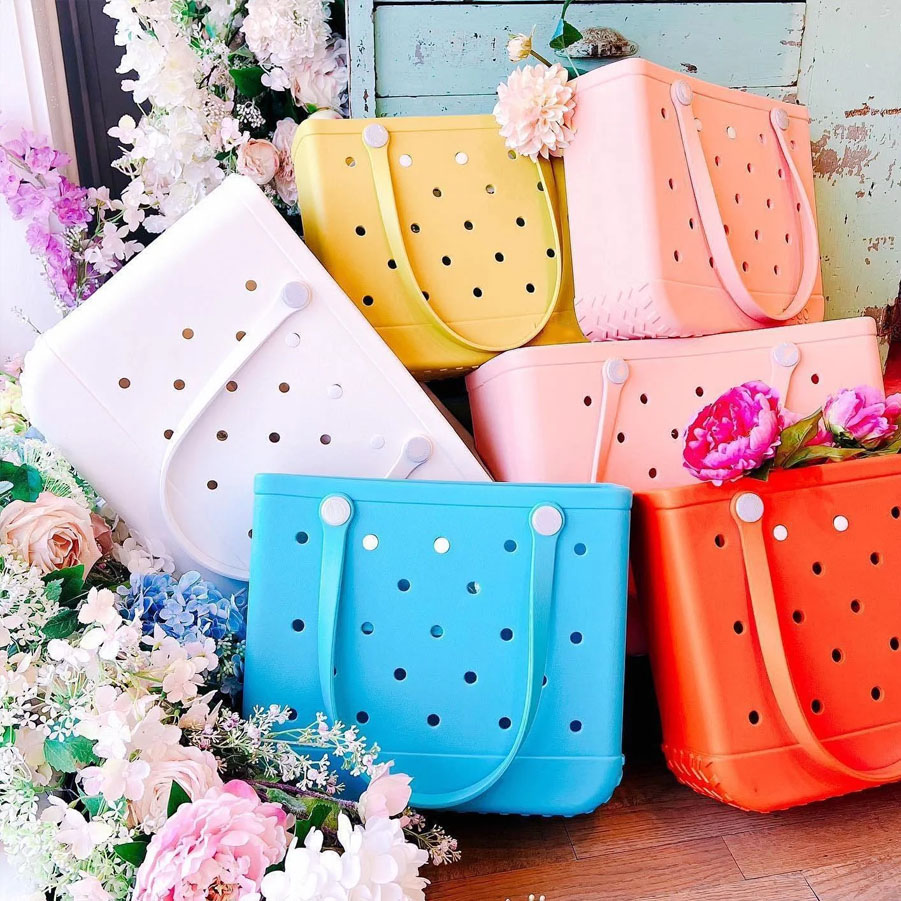
The “working principle” of an EVA beach bag is mainly based on the physical properties of its material and molded structure rather than a mechanical system.
First, the EVA material creates a relatively moisture-resistant outer surface. When water or splashes come into contact with the bag, the material helps prevent moisture from readily penetrating the bag body. This is particularly useful when carrying items around swimming pools, beaches, resorts, and other wet environments.
Second, the molded structure provides dimensional stability. A properly designed EVA bag can remain upright instead of collapsing like a soft fabric tote. This makes it easier to place and remove towels, clothing, toys, bottles, and other belongings.
Third, EVA's lightweight structure reduces the overall carrying weight. This is important because beach bags are often filled with relatively bulky items. A lightweight bag allows more of the user's carrying capacity to be used for personal belongings rather than the bag itself.
Finally, the smooth surface makes cleaning relatively simple. Sand, dust, sunscreen residue, and water can usually be removed by wiping or rinsing the exterior.
However, it is important to distinguish between water resistance and complete waterproof protection. An EVA bag body may resist water very effectively, but zippers, seams, openings, accessory attachment points, and construction details can influence the overall water protection of the finished product. Some manufacturers market EVA beach totes as waterproof, but performance depends on the specific design and construction.
The manufacturing process is an important factor in determining the final performance, appearance, and durability of EVA bags.
The process starts with selecting an appropriate EVA compound. Manufacturers may consider density, hardness, flexibility, thickness, color, and other physical properties according to the intended application.
For example, a large beach tote designed to carry towels and multiple personal items may require a different material structure from a small lightweight summer handbag.
Material formulation can also influence the final tactile feel and structural rigidity of the bag.
The next step is product development. Engineers create the bag's dimensions, wall thickness, handle structure, bottom construction, opening, decorative elements, and other features.
For molded EVA products, mold design is particularly important because the mold determines the basic shape and dimensional accuracy of the finished product.
Manufacturers can also develop different textures, patterns, embossed logos, perforations, and decorative details according to the product design.
Depending on the product structure and manufacturing method, EVA beach bags can be produced using processes such as cutting, compression molding, or injection molding.
In compression molding, EVA material is heated and placed into a mold before pressure is applied to form the required shape. Injection molding involves heating the EVA compound and injecting it into a mold, followed by cooling and solidification.
The choice of molding process depends on the product design, material formulation, production volume, dimensional requirements, and desired appearance.
After molding, excess material or flash may remain around the edges. These areas are trimmed and finished to improve the appearance and dimensional consistency of the product.
Depending on the design, additional processing may include surface treatment, perforation, logo embossing, printing, or decorative finishing.
Handles, zippers, lining materials, buttons, decorative components, or other Accessories may then be assembled.
Quality inspection normally focuses on dimensions, surface appearance, molding consistency, handle attachment, edge quality, color consistency, and overall structural integrity.
For custom production, manufacturers may also inspect the product against approved samples and customer specifications before mass production and shipment.
The popularity of EVA beach bags comes from several practical advantages.
EVA provides a relatively lightweight material solution, which is valuable for large beach totes that may already carry towels, clothing, food, drinks, and recreational items.
Water resistance is one of the main reasons consumers choose an EVA beach tote. The material is suitable for environments where splashes and moisture are common, including beaches, swimming pools, water parks, and resorts.
Unlike many fabric bags, EVA surfaces do not readily absorb liquids. Users can generally wipe the surface or rinse it with water after outdoor activities. This makes maintenance particularly convenient when the bag comes into contact with sand, sunscreen, or wet clothing.
Molded EVA can provide a self-supporting structure that helps the bag remain upright. This can improve accessibility and make it easier to organize larger items.
EVA can be produced in different colors, shapes, thicknesses, and surface finishes. Manufacturers can also incorporate custom logos, embossed patterns, and other visual elements.
This makes custom EVA beach bags attractive for fashion brands, resorts, promotional campaigns, retailers, and private-label products.
Because EVA bags can be cleaned and reused, they are suitable for repeated beach trips, pool visits, travel, gym sessions, and other outdoor activities.
Despite their advantages, EVA beach bags are not suitable for every application.
One limitation is storage. A structured molded bag may not fold as compactly as a fabric tote, which can make it less convenient to store in small spaces. This has also been noted in consumer testing of EVA bags.
Another consideration is temperature and long-term environmental exposure. EVA properties can vary depending on formulation, and prolonged exposure to high temperatures or ultraviolet radiation may affect the appearance or physical performance of some products.
EVA is also a synthetic polymer, so manufacturers and brands should consider material sourcing, product lifespan, recyclability, and end-of-life management when developing sustainable product strategies.
Finally, the overall performance of an EVA bag depends on more than the material itself. Handle design, wall thickness, mold quality, attachment methods, closures, and manufacturing quality can all influence the durability of the finished product.
Although beach use remains the most obvious application, modern EVA bags are much more versatile.
The combination of water resistance, easy cleaning, and large capacity makes EVA bags suitable for towels, swimwear, sunscreen, sunglasses, sandals, toys, and other beach essentials.
EVA bags are also useful around swimming pools because they can handle frequent exposure to water and are relatively easy to clean.
A lightweight EVA tote can be used during vacations, resort stays, cruises, and weekend trips. Its structured design can make it convenient for carrying personal items between hotels, beaches, and outdoor destinations.
The easy-clean surface is also useful for gym users carrying towels, clothing, shoes, and other fitness accessories.
EVA bags can be used for picnics, camping, boating, festivals, and other outdoor activities where lightweight construction and easy maintenance are important.
For brands, resorts, hotels, and retailers, EVA bags provide opportunities for customized colors, logos, patterns, packaging, and product dimensions. This makes them suitable for private-label and promotional projects.
The popularity of EVA beach bags comes from the combination of several product characteristics rather than a single feature.
Traditional fabric beach bags can be attractive and flexible, but they may absorb water and retain sand. EVA provides a smoother and easier-to-clean alternative. At the same time, molded EVA can create a structured shape without requiring the same type of internal construction used in some traditional bags.
For consumers, this means a beach bag can be lightweight, easy to clean, visually appealing, and practical for wet outdoor environments.
For brands and manufacturers, EVA offers another important advantage: design flexibility. The material can support different colors, shapes, textures, thicknesses, logos, and product configurations. This makes it possible to develop products for different market segments, from simple promotional totes to premium summer accessories.
The current market also shows that EVA beach bags are increasingly positioned beyond the beach itself. They are being promoted for pools, travel, gyms, shopping, camping, and everyday outdoor use, reflecting a broader demand for versatile lifestyle products.
EVA beach bags have become popular because they solve several practical problems associated with traditional beach bags. Their lightweight structure, moisture resistance, easy-clean surface, molded shape, and customization possibilities make them suitable for both consumers and commercial brands.
From material selection and mold design to molding, trimming, assembly, and quality inspection, every stage of production can influence the final product. Choosing the right EVA formulation and manufacturing process is therefore essential for achieving the desired balance of flexibility, durability, appearance, and cost.
For consumers, an EVA beach bag can be a convenient choice for beach days, pool activities, travel, and outdoor recreation. For businesses, custom EVA beach bags provide opportunities to combine practical functionality with brand identity and product differentiation.
As outdoor lifestyles and functional fashion continue to develop, EVA remains a practical material for designing lightweight and easy-to-maintain bags for a wide range of applications.



Mobile: +86-135-3230-8701
E-mail:DGluneng001@njdbj.com
Add: 202, Building 1, No. 3, Huangjiang North Bank Fourth Road, Dongguan, Guangdong, China
© 2026 Dongguan Lvneng Rubber And Plastic Products Co., Ltd. All rights reserved.
Privacy policy | Terms and Conditions