
Blog
Follow us - Get quick access to the latest industry news!


2026-09-03 23:25:33
EVA is widely used in products that may come into contact with water, including footwear, marine flooring, packaging, sports equipment, gaskets, insulation materials and protective pads. Because of its closed-cell structure and low water absorption, EVA foam is often described as a waterproof or water-resistant material. But is EVA 100% waterproof?
The short answer is: high-quality closed-cell EVA foam has excellent waterproof and moisture-resistant properties, but it is more accurate to describe EVA as highly water-resistant rather than universally 100% waterproof. The actual performance depends on the EVA formulation, cell structure, density, thickness, manufacturing process, surface condition and how the finished product is assembled.
Understanding how EVA works can help manufacturers, engineers and buyers select the right material for applications exposed to water, humidity or outdoor conditions.
EVA stands for Ethylene Vinyl Acetate, a copolymer made by combining ethylene and vinyl acetate. Depending on the vinyl acetate content and formulation, EVA can be produced with different levels of flexibility, softness, elasticity and impact resistance.
EVA foam is manufactured by introducing a cellular structure into the polymer material. In many industrial applications, the foam has a closed-cell structure, meaning that individual cells are largely sealed rather than connected to one another.
This structure is one of the main reasons EVA foam has low water absorption.
Compared with open-cell materials such as some polyurethane foams, closed-cell EVA foam does not provide interconnected pathways for liquid water to easily travel through the material. Commercial EVA foam specifications commonly show very low water absorption, although the exact value varies by grade and test method. For example, technical data from EVA foam manufacturers lists low water absorption alongside fine cell structure and other mechanical properties.
Therefore, when people ask “Is EVA waterproof?”, they are usually referring to closed-cell EVA foam, rather than every possible EVA product.
The main reason is the closed-cell foam structure.
During the foaming process, gas is introduced into the EVA polymer matrix, creating numerous small cells. When these cells remain closed, water has significantly fewer pathways into the interior of the material.
Think of the difference between a sponge and a sealed foam structure. An open-cell sponge contains interconnected pores, allowing water to move through and remain inside the material. A closed-cell EVA foam contains mostly isolated cells, which limits water penetration and reduces moisture absorption.
This structure provides several useful properties:
Low water absorption
Good moisture resistance
Buoyancy
Lightweight construction
Shock absorption
Thermal insulation
Flexibility
Chemical resistance
Some closed-cell EVA products are specifically engineered for marine and outdoor applications because their cellular structure helps prevent water absorption.
However, waterproof performance should not be judged by the material alone. Cut edges, holes, seams, adhesives, laminations and joints can affect the water resistance of the finished product.
For example, an EVA foam sheet may have excellent water resistance, but if two sheets are joined incorrectly or the product contains unsealed openings, water can still enter the overall assembly.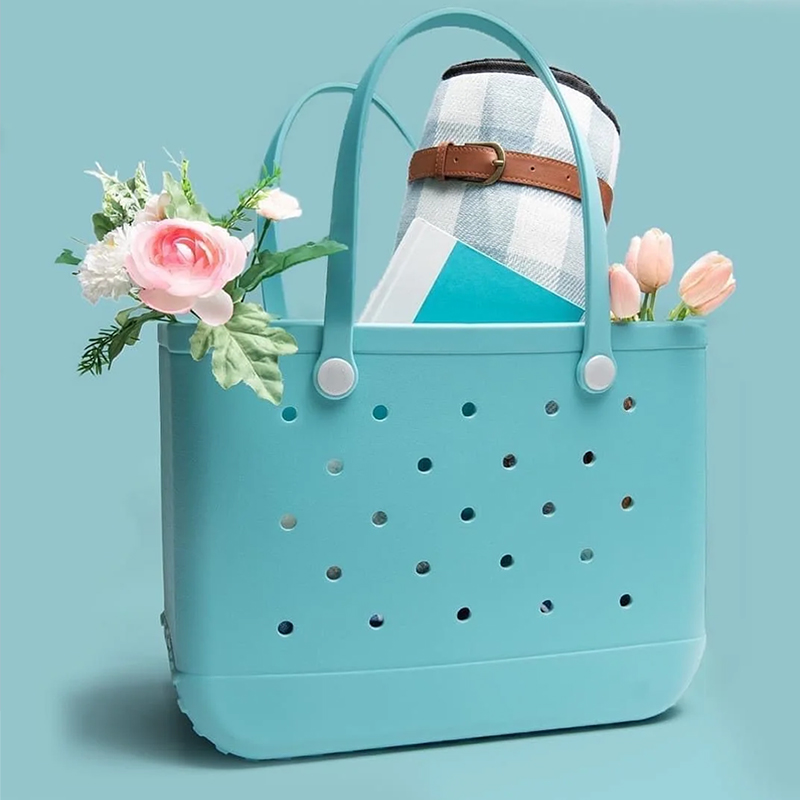
The waterproofing mechanism of EVA foam can be understood through three main factors: polymer structure, closed-cell morphology and surface characteristics.
EVA is a thermoplastic copolymer consisting primarily of ethylene and vinyl acetate. The polymer itself has relatively low affinity for liquid water compared with highly hydrophilic materials.
The proportion of vinyl acetate can influence flexibility, elasticity and other physical properties. Therefore, different EVA grades can behave differently even though they are all classified as EVA.
Cell morphology is particularly important for EVA foam.
A fine and uniform closed-cell structure reduces the pathways available for liquid water penetration. Higher-quality foam production focuses on controlling parameters such as cell size, cell distribution and density.
This is why closed-cell EVA foam is generally much more water-resistant than open-cell foam.
The surface of EVA can also affect practical water resistance. A smooth, dense surface can shed water efficiently, while textured or mechanically damaged surfaces may retain small amounts of moisture.
The important distinction is that water resistance of the material is not necessarily the same as waterproofing of the complete product.
The manufacturing process has a direct influence on the final water resistance, density and mechanical performance of EVA foam.
A typical EVA foam manufacturing process includes several stages.
The primary material is EVA resin. Manufacturers may combine the resin with additives such as:
Blowing agents
Crosslinking agents
Stabilizers
Pigments
Processing aids
Fillers
The formulation is adjusted according to the required density, hardness, flexibility, resilience and application.
The EVA resin and additives are mixed under controlled temperature and processing conditions.
The goal is to achieve uniform dispersion of the ingredients throughout the polymer matrix. Uneven mixing can lead to inconsistent cell structure and mechanical properties.
Foaming is one of the most important stages.
Heat causes the blowing agent to generate gas, which expands within the EVA polymer matrix. This creates the cellular structure that gives EVA foam its lightweight and cushioning characteristics.
The manufacturing process must control variables such as temperature, pressure, expansion ratio and formulation.
Many EVA foam products use cross-linked EVA foam.
Crosslinking improves dimensional stability, elasticity, resilience and resistance to deformation. It can also help maintain a stable cellular structure during and after foaming.
Some EVA foam technologies use chemical crosslinking, while other manufacturing approaches use different physical or chemical methods depending on the target application. A technical data sheet for EV50, for example, identifies the material as closed-cell, cross-linked EVA copolymer foam.
After expansion and stabilization, the foam is cooled and processed into sheets, rolls, blocks or molded components.
Depending on the application, EVA can subsequently undergo:
Die cutting
CNC machining
Laminating
Thermoforming
Compression molding
Adhesive backing
Surface texturing
The final manufacturing process determines how the material is converted into a usable component.
EVA foam is popular because water resistance is only one of its performance characteristics.
Closed-cell EVA foam generally absorbs very little water compared with open-cell foam. Specific values vary according to density, formulation and test method. Some commercial EVA specifications report extremely low water absorption values.
This makes EVA suitable for wet environments and products that need to remain lightweight after exposure to water.
EVA foam has a cellular structure containing a large amount of gas, resulting in relatively low density.
This makes it useful for footwear, packaging, sports equipment, flotation components and protective products where reducing weight is important.
EVA can absorb and distribute impact energy, making it suitable for protective padding, sports equipment, shoe midsoles, packaging inserts and industrial cushioning.
Depending on its formulation and density, EVA can provide a balance of flexibility, elasticity and compression resistance.
This allows manufacturers to select different EVA grades for soft cushioning products or more rigid structural components.
EVA foam generally provides good resistance to many chemicals and environmental conditions, although chemical compatibility should always be evaluated for the specific application.
The cellular structure also gives EVA foam useful thermal insulation properties. Certain EVA foam products are therefore used in insulation and temperature-control applications.
Although EVA has many advantages, it is not the perfect material for every application.
The biggest misconception is that every EVA product is automatically 100% waterproof.
Different EVA formulations, foam structures and manufacturing methods can produce different water absorption results. In addition, the finished product may contain seams, adhesive layers, perforations or damaged surfaces.
Therefore, engineers should evaluate the complete product rather than relying only on the name “EVA.”
EVA has a defined service temperature range. Excessive heat can affect dimensional stability, hardness and mechanical performance, while very low temperatures can change flexibility depending on the formulation.
For applications involving continuous exposure to extreme temperatures, the specific grade should be tested before production.
Outdoor exposure can involve ultraviolet radiation, heat, moisture and oxidation. EVA can be formulated with stabilizers and other additives to improve weather resistance, but long-term outdoor performance still depends on the formulation and application conditions.
When EVA foam is continuously compressed, it may gradually lose some of its original thickness and resilience.
For seals, gaskets and load-bearing cushioning applications, compression set should therefore be considered alongside density, hardness and tensile strength.
Because of its combination of water resistance, lightweight construction, flexibility and cushioning, EVA foam is used across many industries.
EVA is widely used in:
Shoe midsoles
Insoles
Sandal soles
Slippers
Sports footwear
Its lightweight structure and shock absorption make it suitable for footwear products.
Closed-cell EVA foam is commonly used for:
Boat flooring
Marine decking
Paddle boards
Surfboards
Water sports equipment
Marine applications particularly benefit from low water absorption, buoyancy and cushioning properties.
EVA foam can be die-cut or CNC-machined into protective inserts for:
Electronics
Tools
Medical equipment
Optical equipment
Industrial instruments
The closed-cell structure helps protect products from impact while reducing moisture exposure.
EVA can be used in automotive interiors, seals, padding, insulation and protective components.
Depending on the application, manufacturers may select specific grades according to density, hardness, compression performance, temperature resistance and flammability requirements.
Common applications include:
Yoga mats
Exercise mats
Protective padding
Sports equipment
Fitness flooring
The combination of cushioning and water resistance makes EVA practical for equipment that is frequently exposed to sweat or moisture.
EVA foam can also be used as a sealing and cushioning material. Closed-cell EVA products can provide water-resistant sealing when properly designed, compressed and installed. Some engineered EVA sealing systems are specifically designed for watertight applications.
When selecting a foam material, buyers should compare EVA with alternatives based on the actual application.
| Property | Closed-Cell EVA | Open-Cell Foam |
|---|---|---|
| Water absorption | Very low | Usually higher |
| Cushioning | Excellent | Good |
| Buoyancy | Excellent | Limited |
| Moisture resistance | Excellent | Lower |
| Weight | Lightweight | Lightweight |
| Flexibility | Good | Good |
| Typical applications | Marine, footwear, packaging, sports | Cushions, acoustic products, furniture |
The most important difference is the cell structure. Closed-cell EVA is designed to limit water absorption, while open-cell materials have interconnected pores that can retain moisture.
Yes, in many cases.
If the product requires low water absorption, moisture resistance, cushioning and lightweight construction, closed-cell EVA can be an excellent material choice.
However, product designers should evaluate more than the base material. Important specifications may include:
EVA density
Hardness
Cell size
Water absorption
Compression deflection
Compression set
Tensile strength
Elongation
Tear strength
Temperature resistance
UV resistance
Chemical resistance
Surface treatment
Adhesive compatibility
For example, commercial EVA foam data sheets commonly specify density, tensile strength, elongation, tear strength, compression set and water absorption rather than simply labeling the material “waterproof.”
So, is EVA 100% waterproof?
For high-quality closed-cell EVA foam, the answer is that it provides excellent water resistance and very low water absorption, making it suitable for many wet, outdoor and marine applications. However, saying that every EVA material is absolutely 100% waterproof can be misleading.
The actual waterproof performance depends on the EVA formulation, closed-cell structure, density, manufacturing process, surface condition and final product design.
For manufacturers and product developers, the better approach is to select EVA according to the required water absorption, mechanical performance, temperature range and environmental conditions, and then verify the finished product through appropriate testing.
In short, closed-cell EVA is an excellent choice when water resistance, lightweight construction, cushioning and durability are required. The right EVA grade and manufacturing process can make a significant difference in the final performance of the product.



Mobile: +86-135-3230-8701
E-mail:DGluneng001@njdbj.com
Add: 202, Building 1, No. 3, Huangjiang North Bank Fourth Road, Dongguan, Guangdong, China
© 2026 Dongguan Lvneng Rubber And Plastic Products Co., Ltd. All rights reserved.
Privacy policy | Terms and Conditions